Most authors never get a call from Hollywood. Some decide not to wait. Writing your own adaptation is one of the few moves in the film business that an author fully controls. Whether it’s the right move depends on what you want from it.
Here is an honest look at the case for, the case against, and what to check first.
First, check who owns the film rights
Before you write a page, read your publishing contract. In many traditional deals the author keeps film and TV rights, but not in all of them, and some contracts give the publisher a share or a say. If you self-published, the rights are almost certainly yours.
If a producer has optioned your book, the screenplay rights may already be committed. Read the option agreement, and when in doubt, ask an entertainment lawyer. (This article isn’t legal advice.)
The case for adapting it yourself
You know the story best. No one understands your characters’ motives, history, and secrets as well as you do. That knowledge is valuable when you have to decide what the film can lose.
A script makes your book easier to pitch. Producers are busy. A novel asks them to imagine the film. A screenplay shows it to them, and it can be read in an evening. Many producers and contests accept scripts based on the writer’s own book.
It opens doors beyond one sale. A writing sample in screenplay format can lead to other work, from contests and fellowships to rewrite jobs. Your adaptation proves you can work in the form.
It sharpens the book. Authors often say adapting showed them their story’s real spine. That clarity helps with sequels, series bibles, and your next novel.
The case against
It’s a new craft. Screenwriting rewards different instincts than prose: compression, visual thinking, and scenes built on action rather than reflection. Expect a learning curve.
You may be too close. The scenes you love most are often the ones a film should cut. Many authors find it hard to make those calls on their own work.
Producers may want their own writer. If your book is optioned, the buyer may bring in an experienced screenwriter regardless. Your script can still help shape their vision, but it might not be the one that’s shot.
A middle path: convert, then adapt
The biggest barrier for most authors isn’t creative. It’s time. Turning a full manuscript into screenplay format by hand, scene by scene, can take months before you even start the real adaptation work.
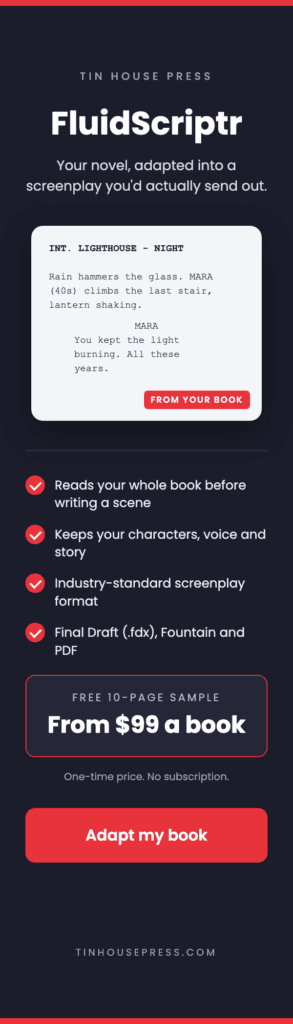
FluidScriptr shortens that stage. It converts your manuscript into a formatted screenplay draft, then runs a Conversion Fidelity Analysis that shows how faithfully the script follows your book. You get something you can read as a film in days, not months.
That makes the decision easier. Read your book as a screenplay first. If it excites you, revise it into a pitch-ready script yourself or bring in a screenwriter with a strong draft in hand. If it doesn’t, you’ve learned something important about your story without spending a season on it.
Questions to ask yourself
- Do I own the film rights, and are they free of options?
- Do I want to write the film, or do I want the book made into a film? Those lead to different paths.
- Am I willing to cut scenes, characters, and lines I love?
- Do I have time to learn screenplay craft, or do I need a faster starting point?
If your answers point toward writing it, start. An author with a finished screenplay is in a stronger position than one with a book and a hope. See your novel as a screenplay with FluidScriptr.
Related reading: How to Turn Your Novel Into a Screenplay · Novel vs. Screenplay: What Changes When a Book Becomes a Script