You spent years on your novel. You know these characters better than anyone. So when people say “this would make a great movie,” the natural next thought is: could I write the screenplay myself?
You can. But a screenplay is not a shorter novel. It is a different machine, built for a different reader, and most first adaptations stall because the author tries to carry the book across intact. Here is how to do it in seven steps.
1. Find the spine of the story
A 90,000-word novel can hold three subplots, a dozen supporting characters, and long stretches of reflection. A feature screenplay runs roughly 90 to 120 pages, and one page plays as about one minute on screen. Something has to go.
Before you cut anything, write one sentence that states what your protagonist wants, what stands in the way, and what it costs them. That sentence is your spine. Every scene you keep should push on it.
2. Make a scene list, not a chapter list
Go through the novel and list every moment that could be filmed: a place, a time, people doing something. Ignore chapter breaks. A single chapter might hold four scenes, or none.
Mark each scene with what changes in it. If nothing changes, it is a candidate to cut or merge.
3. Cut and combine characters
Adaptations routinely fold two or three minor characters into one. The best friend who gives advice and the coworker who delivers bad news can often be the same person. Fewer faces means each actor has more to play, and the audience has less to track.
4. Turn thought into action
This is where most author-adaptations struggle. In the novel, your heroine realizes she no longer trusts her sister. On screen, the camera cannot see a realization. It can see her hide a letter, change a lock, or stop answering a call.
For every important internal beat, ask: what would she do because of this? Write that. Voiceover is available, but it works best as a deliberate style choice, not a patch for interiority you couldn’t dramatize.
5. Rebuild the structure
Novels can wander. Films are less forgiving. Map your scene list onto a three-act shape: the setup and inciting incident in roughly the first quarter, escalating complications through the middle, and a climax that answers your spine sentence. You may need to move events earlier, compress timelines, or give the midpoint a sharper turn than the book had.
6. Format it correctly
Screenplay format is strict for a reason: it lets producers, directors, and actors estimate length and budget at a glance. Every scene starts with a slugline (INT. KITCHEN – NIGHT), action is written in present tense, and dialogue sits centered under the character’s name. A script with formatting errors signals inexperience before anyone reads the story.
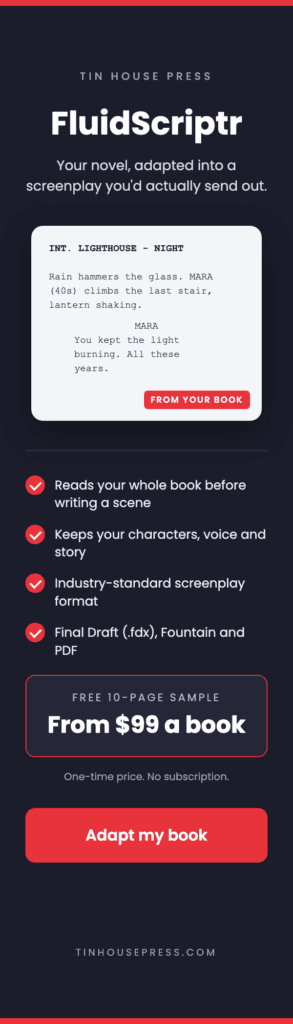
This is the step where a tool earns its keep. Retyping 300 pages of prose into screenplay format by hand takes weeks. FluidScriptr handles the manuscript-to-screenplay conversion for you: upload your manuscript and it produces a properly formatted screenplay draft, with sluglines, action, and dialogue laid out to industry standard. Its Conversion Fidelity Analysis then shows how closely the script tracks your source, so you can see which threads survived and which fell away.
That draft is a starting point, not a finished script. But starting your revision from a formatted, scene-by-scene draft instead of a blank page changes how fast you can get to step seven.
7. Revise like a screenwriter
Read the draft aloud. Cut any line of dialogue that explains what the audience can already see. Trim action blocks to three or four lines each. Then hand it to someone who hasn’t read your book. If they can follow it without the novel’s context, it works as a film.
The short version
Adapting your own novel means letting go of the things only prose can do and leaning into what film does best: visible action, compressed time, and scenes where something changes. Find your spine, cut hard, dramatize the inner life, and get the format right.
If you want a formatted first draft to work from, try FluidScriptr and see what your book looks like as a script.
Related reading: Novel vs. Screenplay: What Changes When a Book Becomes a Script · Should You Adapt Your Own Book Into a Screenplay?