
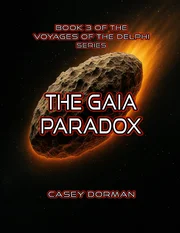

Ezekiel is an artificial intelligence aboard the spaceship Delphi; the rest of the crew consists almost entirely of humanoid androids from the Solarian civilization. Their mission is to seek out other intelligent lifeforms throughout the galaxy, attempt to contact them, and learn more about them (“Our mission is to learn,” notes Hero, the ship’s captain). Although Ezekiel is humanoid, too, he’s not a Solarian; he’s an exact copy of the human scientist who created him, with the same memories and feelings, but less physically vulnerable than the ship’s only human, Siaree. The crew is on a mission of peace to the planet Travoli, which is entirely populated by humans; the robots there exist only to serve the inhabitants and are assumed to have subhuman intelligence. When the Delphi arrives, they discover that Fesgard, the warlike Travolian whom they already know, isn’t on the planet. Instead, he and his crew appear to have stopped on their way home from the Trappist-1 planetary system to take samples from an unknown asteroid. They soon became mysteriously, dangerously ill—and cannibalistic. Now Ezekiel and his crew must investigate; fortunately, they’re immune to whatever is infecting the humans. This is the final book in Dorman’s trilogy, but it stands well on its own. The prose is lucid and flows well, both in action sequences and in interpersonal scenes, and it always keeps the scientific aspects of the story clear. There’s potential in the idea that Ezekiel is a human-derived AI, and therefore significantly different from the other beings he works with; it’s mostly used as an excuse, though, to have Ezekiel think and act like a human from the late 20th or early 21st century, which can feel a bit ham-fisted. Other elements of the book are a bit too similar to Star Trek, including a female empath and a non-interference Prime Directive. Still, this is an engaging read, particularly for those interested in AI, androids, and artificial environments.
