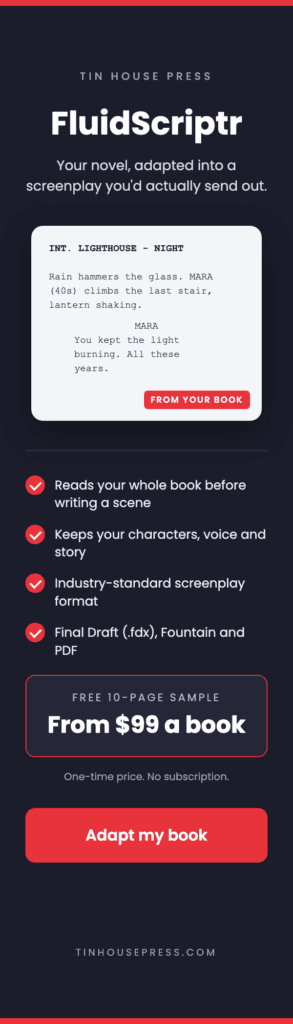
FluidScriptr: what it is, and how it actually works
An adaptation tool that reads your whole novel before it writes a single scene — what it does, how the Story Bible works, and what carries over from your book.
An adaptation tool that reads your whole novel before it writes a single scene — what it does, how the Story Bible works, and what carries over from your book.
Comparing the best manuscript assessment tools in 2026 — Marlowe, Inkshift, Fictionary, AutoCrit, ProWritingAid and human editors. Which one actually answers the question you’re asking? Every writer who finishes a draft arrives at the same problem: you have read the thing so many times you can no longer see it. You need an outside read. …
Neither path is the right one. Both paths are the right one. Here’s how to think about it. The question gets asked constantly, in writing workshops and online forums and conversations at book festivals: Should I self-publish, or should I try to go the traditional route? It’s the wrong question — or rather, it’s the …
The publishing industry will not save you. Here’s what actually works. There is a fantasy that many first-time authors carry into publication: the idea that once the book is out, the publisher takes over. That publicists make calls, reviews appear, bookstore events fill up, and the work of writing is replaced by the more glamorous …
Without a publisher’s machine behind you, the strategy has to be yours. Here’s where to start. The self-publishing marketing conversation tends toward two extremes: breathless accounts of authors who went viral and made millions, and bitter warnings that without a publisher’s distribution you’ll sell twelve copies to family members. Neither is useful. The reality is …
I edit fiction for a living. I’ve read manuscripts sentence by sentence, argued with writers about a single comma, and spent whole afternoons on whether a character would say “okay” or “fine.” So when people find out I don’t treat AI as an enemy in that process, they usually want an explanation. Fair enough. Here’s …
A guide for writers trying to get published — without losing themselves in the process The rejection letter arrives, and you do what writers do: you read it once, close your laptop, and make tea you don’t drink. Then you read it again. Then you spend twenty minutes parsing the phrase “not quite right for …
KDP, IngramSpark, Draft2Digital — here’s how to choose without regretting it later The first real decision a self-publishing author faces isn’t the cover or the price or the launch strategy. It’s the platform — and it’s a decision that shapes everything downstream, from where your book appears to how much you earn per sale to …
Someone asked this in a writing group last week, and meant it sincerely. It usually gets asked rhetorically — as a way of ending the argument rather than having it. This time it wasn’t, so it deserves a real answer. Here’s mine: the question contains a hidden assumption, which is that good is the only …
The technical side of getting your book ready to upload — without losing your mind Formatting is the part of self-publishing that nobody warns you about until you’re already deep in it. You’ve written the book. You’ve edited it. You feel done. And then you discover that uploading a Word document to a print-on-demand platform …