A tool by Tin House Press
Every novelist has had the thought at least once, usually while describing their book to someone at a party: this would make a good film. And then the thought dies there, because the distance between a finished novel and a screenplay a producer will read is about four months of work in a format most novelists have never written in.
FluidScriptr is our attempt to shorten that distance without cheapening the book.
What it is
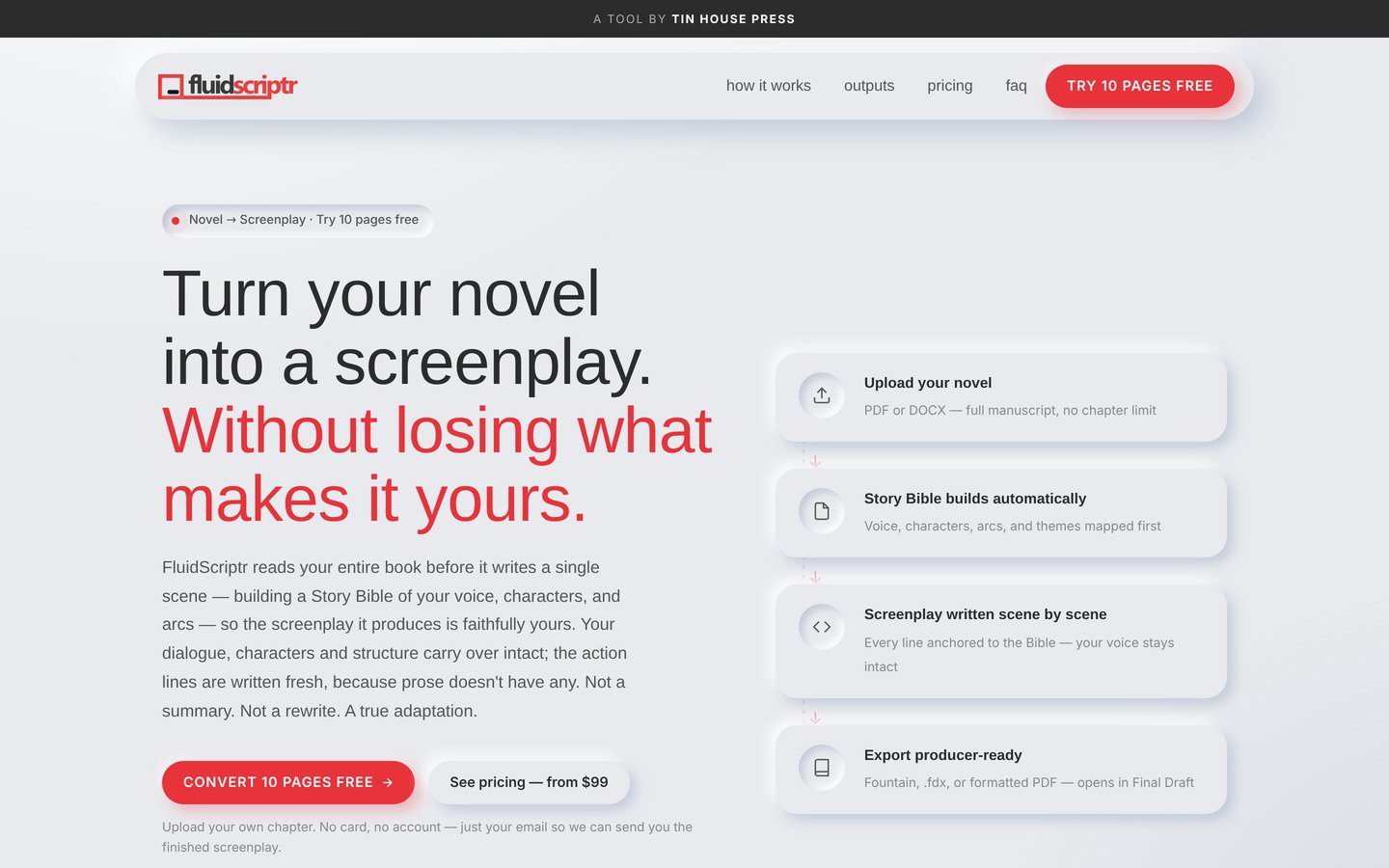
FluidScriptr is an adaptation tool. You upload your novel — PDF or DOCX, the whole manuscript, no chapter limit — and it produces an industry-standard screenplay you can open in Final Draft.
It is not a ghostwriter. It doesn’t invent your story, and it isn’t a summarizer that hands back a treatment. It takes the book you wrote and translates it into the shape the screen requires.
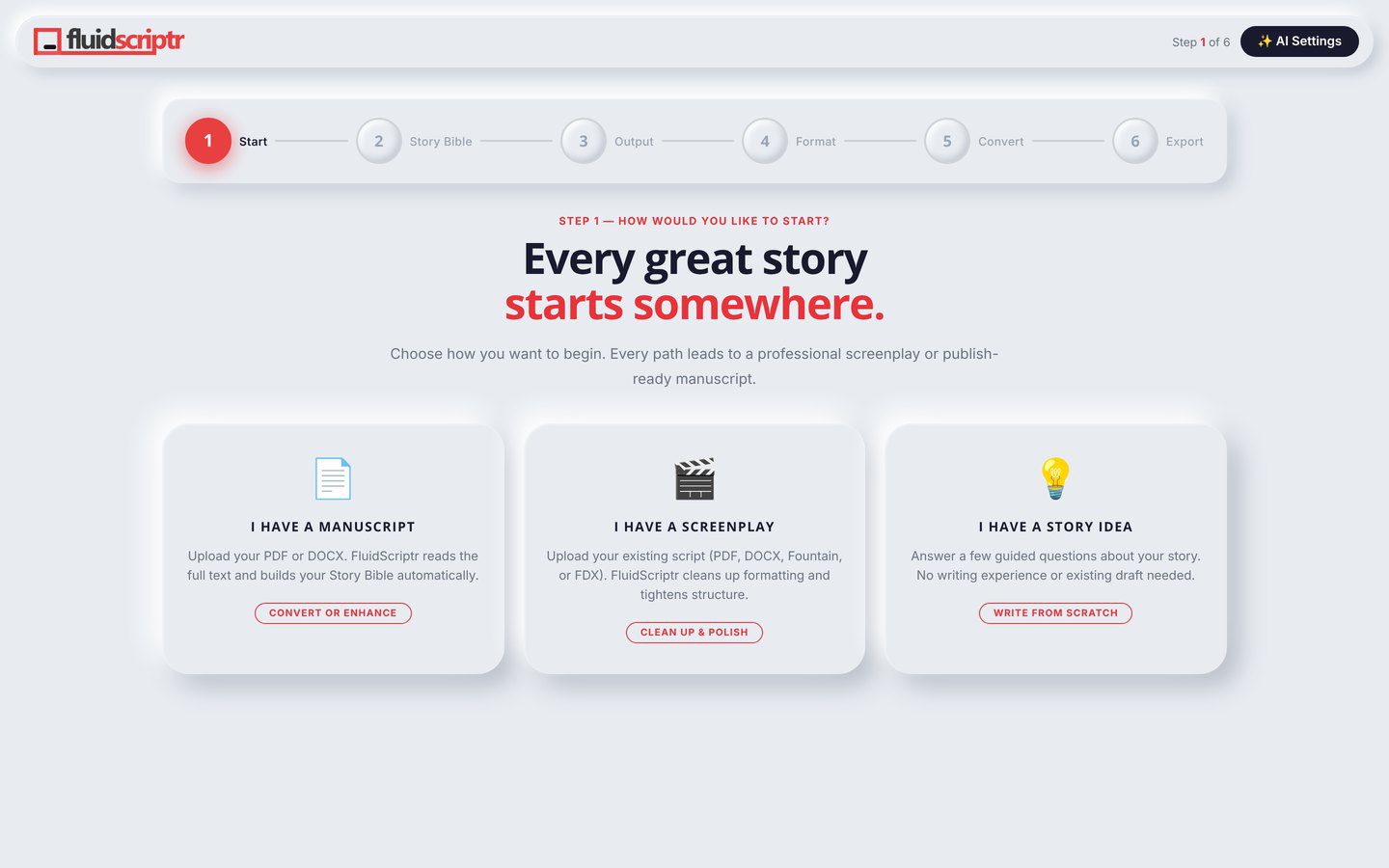
Three other things come out of the same engine, because once it has read your book it may as well be useful in more than one direction:
- Screenplay clean-up — you already have a draft; it fixes the formatting and tightens the structure.
- Manuscript enhancement — a structural pass on pacing, dialogue and prose for a novel that isn’t finished.
- Idea to manuscript — six guided questions, and it builds a draft from scratch.
The problem it was built to solve
Here is the thing that makes AI adaptation hard, and it isn’t formatting.
A language model can only work with what you hand it in a single request. A full novel doesn’t fit in one request, so every tool that handles book-length work has to break the book into pieces. And the moment you do that, chapter fourteen has no idea what happened in chapter three. Characters drift. A minor figure’s name gets spelled two different ways. The voice flattens into competent, generic screenplay prose. What comes back reads like an imitation of your book rather than your book.
That’s the specific failure FluidScriptr was built around.
How it works, in plain English
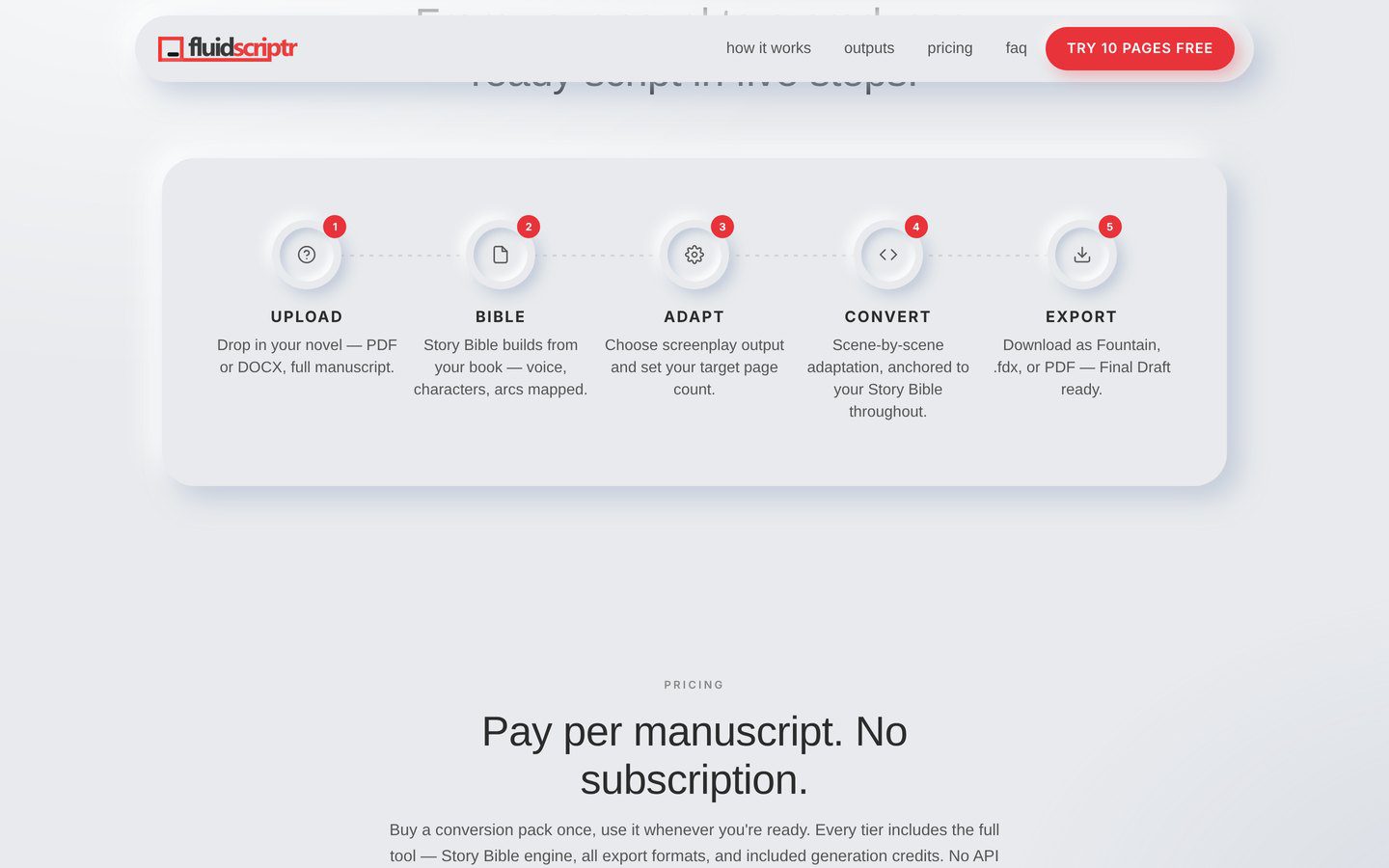
1. It reads the whole book first.
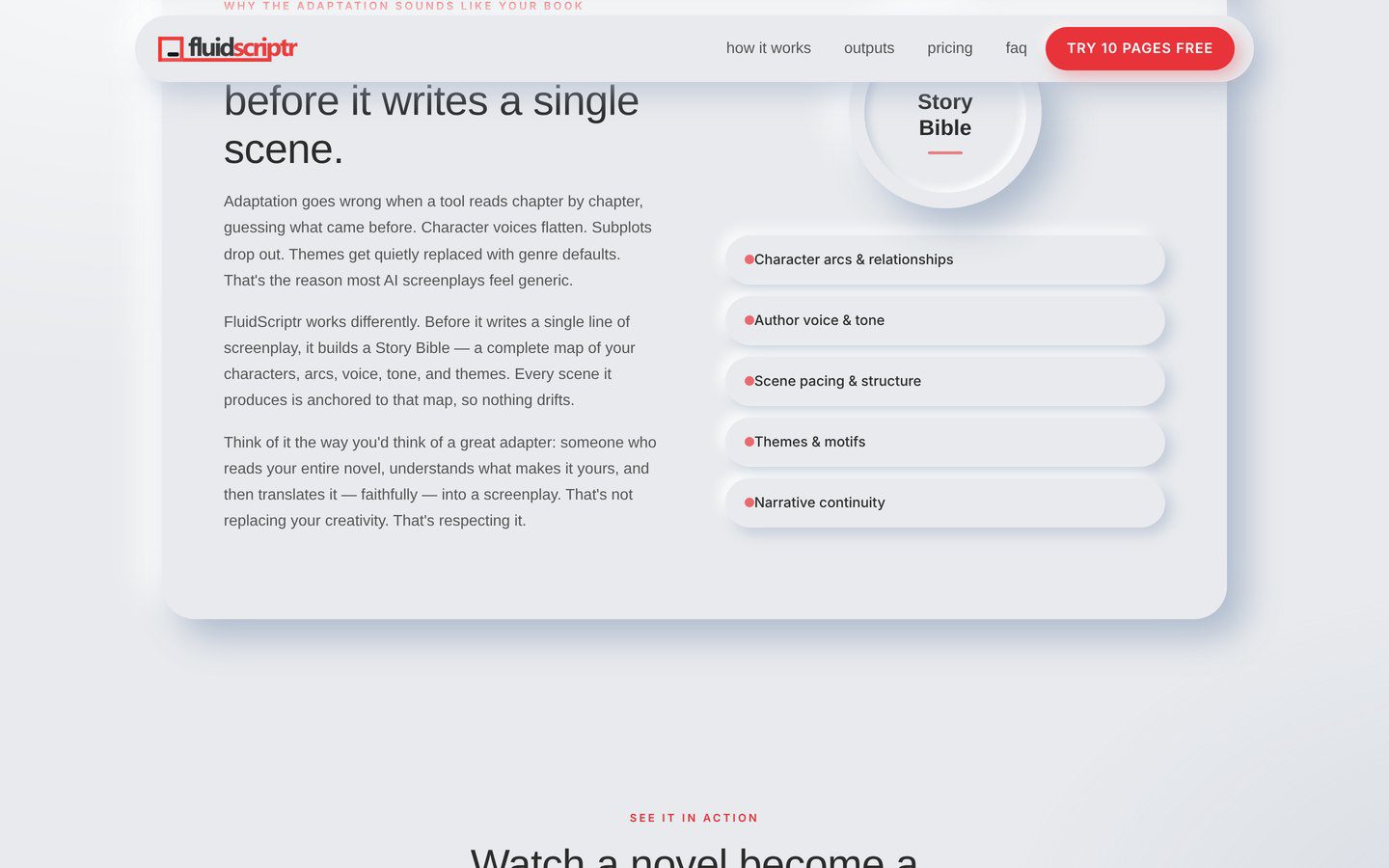
Before it writes a single line of screenplay, FluidScriptr goes through your entire manuscript and builds what we call a Story Bible — a structured map of your characters, their arcs and relationships, your voice and tone, the pacing, the themes. Think of it as the notes a very attentive reader would take.
You get to read that Bible and edit it before anything is converted. If it has misread your protagonist, you fix it there, and every scene that follows inherits the correction.
2. Every scene is written with the Bible in hand.
The book still gets processed in sections — that part is unavoidable. The difference is what travels with each section. Along with the pages themselves, every section carries the full Story Bible and an exact roster of proper names pulled from your manuscript, with an instruction never to vary a spelling or invent one.
That name roster exists because of a real bug. A character introduced in section two and returning in section six was, from the model’s point of view, a total stranger — so it filled the gap plausibly and the author got two names for one person. The fix wasn’t a bigger, more expensive model; a bigger model would have made the same mistake in better prose. The fix was making sure every request could see the same facts. That’s most of what the Story Bible is for.
3. It tells you what your book can actually support.
A 16,000-word memoir will not fill a 110-page feature, no matter what anyone promises. FluidScriptr works out the realistic page count from your word count and dims the formats your source can’t fill, showing you how many words each would need. Feature, limited series, short film — you see what fits before you commit, and the estimate you’re shown is the length that actually gets written.
4. You export it in the format the reader expects.
Screenplays come out as Fountain, Final Draft (.fdx) and formatted PDF. Manuscripts export as DOCX, PDF and RTF — Times New Roman, double-spaced, one-inch margins, submission-ready from the first export.
The honest part: what carries over, and what doesn’t
This matters more than any feature, so we’d rather say it plainly than let you find out afterwards.
Your dialogue carries over close to verbatim wherever it plays on screen. Your characters, structure, arcs and themes are locked by the Story Bible before generation starts.
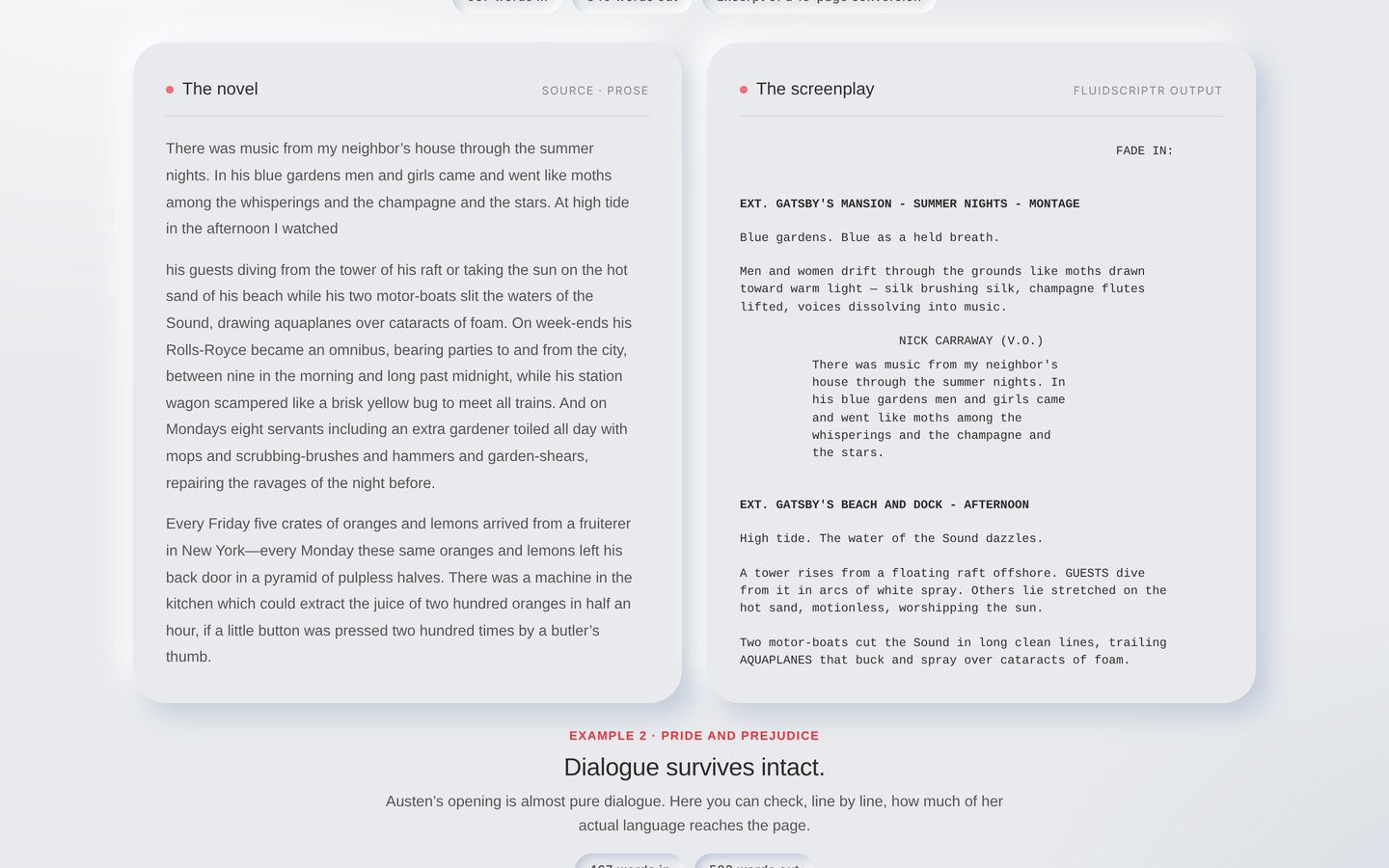
The action lines are new writing. They have to be. A novel has no action lines — it has a narrator, and a narrator’s interior observation has to become something an audience can watch. When Austen tells you a man is insufferable, the screen has to show him being insufferable. So expect your story and your dialogue back, plus new connective prose in the stage directions.
Rather than ask you to take our word for it, we published a page of real, unedited output: a page of a novel beside the screenplay it produced, in a single pass, with no clean-up and no cherry-picking.
There are two examples on it, chosen deliberately. The Great Gatsby‘s third chapter is almost pure description — the hard direction, and where the most new writing happens.
Pride and Prejudice opens with almost pure dialogue, which lets you check line by line how much of Austen’s actual language survives.
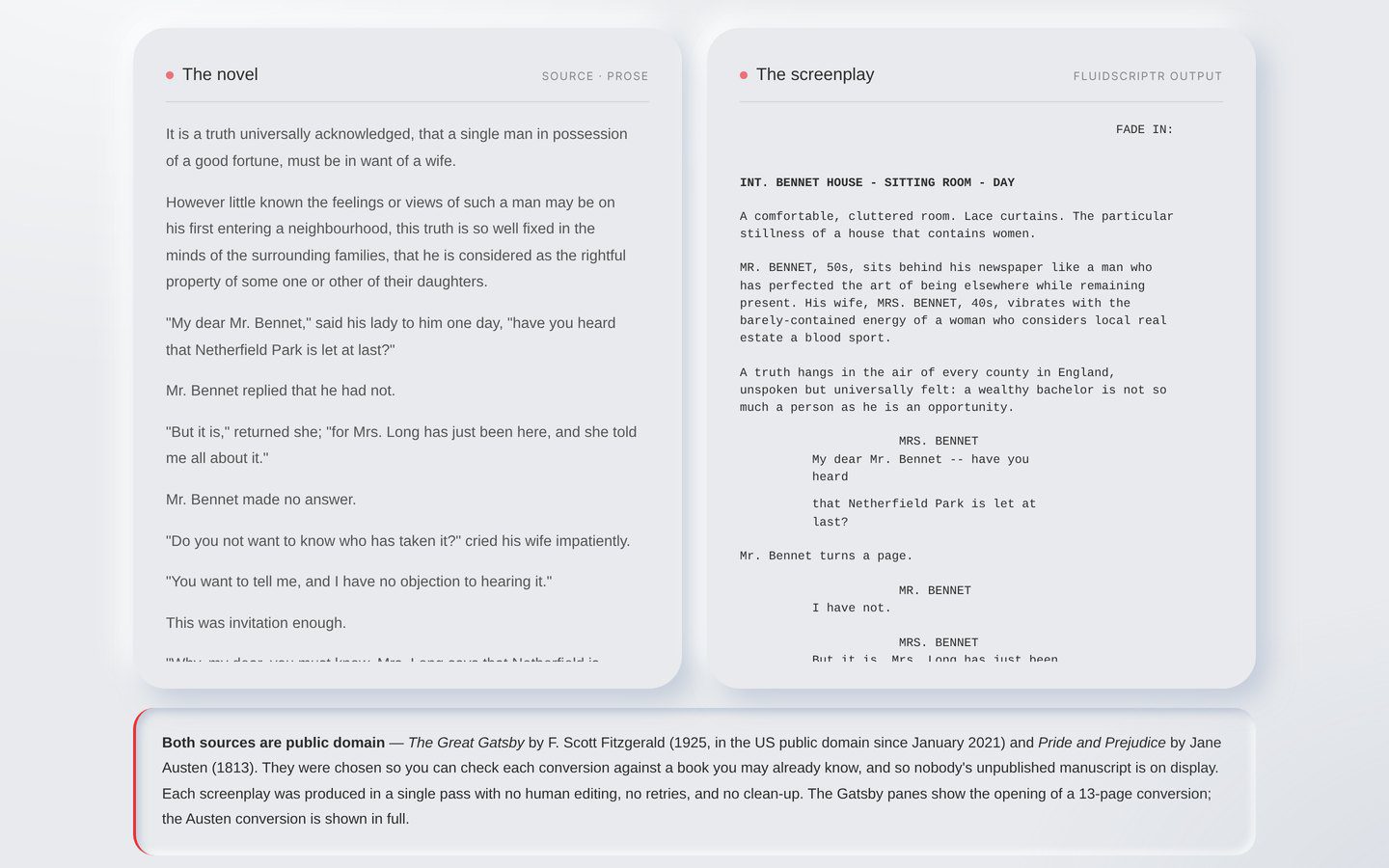
Both sources are public domain, so you can check the conversion against something you may already know — and so nobody’s unpublished manuscript is on display.
Try it on your own book before you pay anything
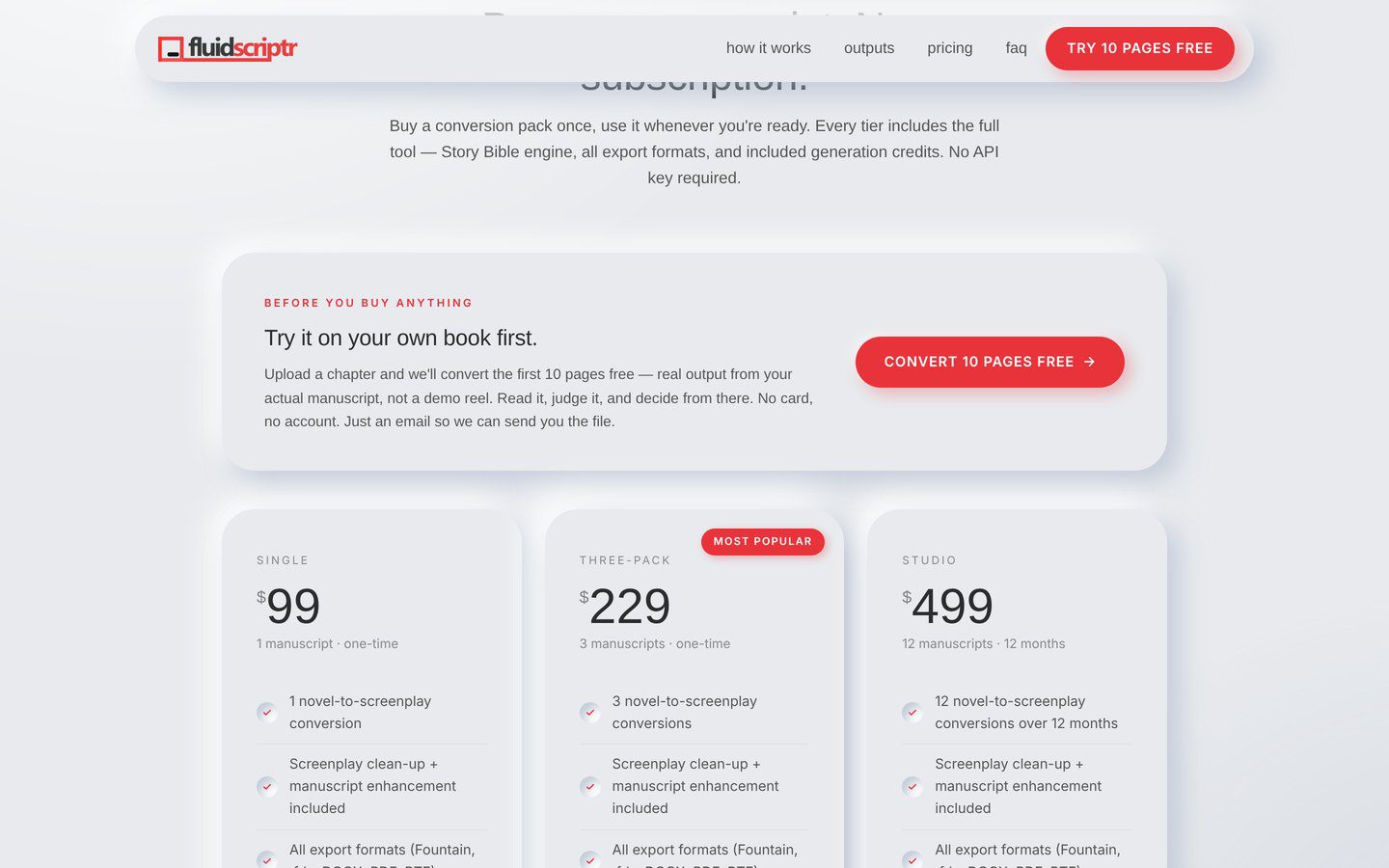
A demo reel proves nothing about your novel. So the first ten pages of your own manuscript convert free — same engine, same Story Bible pass, same formatting paying customers get. No card, no account. We ask for an email so we can send you the finished file.
Ten pages isn’t a screenplay, and it won’t adapt your book for you. It’s enough to judge whether the writing holds up.
If it does, the packs are one-time purchases rather than a subscription: $99 for a single manuscript, $229 for three, and $499 for the twelve-conversion Studio tier. Every tier includes the whole tool and enough generation credits to run it — no API key required. If you’d rather run unlimited conversions, you can add your own Anthropic API key and pay Anthropic directly.
On your manuscript
Your uploads are not retained, and your work is never used to train any model. With included credits, requests pass through our servers to Anthropic but aren’t stored — we keep anonymous usage counts and nothing else. If you use your own API key, it lives only in your browser and requests go straight to Anthropic.
Conversions are powered by Claude Sonnet, from Anthropic.
Convert 10 pages of your own book, free →
See the full product page and pricing · Read a real conversion, unedited
FluidScriptr is a tool by Tin House Press.