
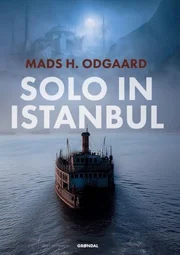

The story opens in 2018, when 23-year-old Miryam’s parents are targeted in the Xinjiang city of Turpan by the Chinese Communist Party, which is forcibly quartering operatives in the households of the Uyghur minority. A man named Xián Quán arrests Miryam’s parents for their participation in acts of terrorism and resistance against the systemic oppression of the Uyghur people. Xián Quán tells Miryam that if she wants her parents to live, she will do as he instructs. The young woman must travel to Istanbul posing as an Uyghur political refugee seeking to join the local dissident movement run by the owner of the Satuk Bugra Han stationery shop; she’s to report on the group’s activities, essentially functioning as a CCP member. “For some reason, life’s harshest realities [have] always struck me as surreal when they hit,” Miryam reflects as she pushes forward, braving brutal travel conditions on foot to reach her destination. With the help of a kindly Kyrgyz couple, she makes her way to Istanbul and applies for political asylum. Miryam is “awestruck and thoroughly beguiled” by the way “the whisper of history” surrounds her there, and she’s warmly welcomed at the Satuk Bugra shop, but she’s soon contacted by CCP agents and reminded of her obligations. She begins gathering and passing along information about the shop’s activities. The Turkish police descend upon the place, leaving Miryam with a hollow feeling inside. “Somewhere in my desperation,” she thinks, “I had betrayed the very people I had come to know here, alone in Istanbul.”
Odgaard’s narrative is rendered turgid by excessive exposition and stodgy pacing at times, but the extensive information dumps are very effective in conveying the troubled history of the Uyghur people and their struggles for freedom from Han Chinese oppression. The psychological portrait of Miryam is slow to coalesce but effective once it’s in place; she’s convincingly human in her flaws and frustrations as she gradually realizes that no matter what she does, she probably can’t help her parents, who are away in a “learning” camp. “Loneliness could be described in many ways,” the depressed Miryam muses; “one of them was precisely this sensation of being locked alone inside one’s own life.” Well-turned phrases like this crop up regularly throughout the text, particularly in the book’s peppier second half, when Miryam meets and comes to know a fellow refugee. The novel’s first half moves far more slowly, but it provides a more detailed picture of the CCP’s treatment of the Uyghurs, with their brutal repression framed as “just business.” The narrative’s intermittent jumps backward and forward in time, while useful for dramatizing historical moments in the Uyghur story, aren’t consistent or compelling enough to justify their disorienting effect, but the heightened pace and livelier dramatic interactions in the story’s climactic sections compensate. Miryam, “infinitely distant from everything [she] loved back home,” emerges as a memorable and winningly sympathetic character.