
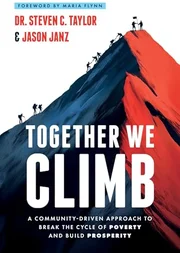

Early on their relentlessly upbeat and energetic narrative, the authors argue that their shared belief in the “American Dream” isn’t at all “naive,” and that “poverty in America is not inevitable.” Instead, they assure their audience that poverty is the result of nebulous “systems and beliefs that limit human potential.” But one has to immediately ask: Have Taylor and Janz failed spectacularly to read the room? With skyrocketing food costs, unaffordable rents, and the overall wealth disparity in the United States exceeding Gilded Age levels—many will no doubt greet a financial self-help book once again extolling “private enterprise” as somewhat suspect–to say the least. Taylor and Janz, however, forge ahead with their analysis despite their seeming tone-deafness to the times. In their approach, however, personal responsibility is somewhat tempered, spreading the job of “teach[ing] a man to fish” across the whole community. The authors call it their “Mountain Model” and it consists of four steps that they say align community action, employer engagement, and policy design with personal responsibility. “Climbing out of poverty is possible, but it requires community, responsibility, and partnership,” the coauthors stress. The thesis is expounded on with brief case studies of hard-pressed working-class Americans desperately trying to make ends meet in an increasingly oppressive economic system. “Tiffany” represents one such case, as the authors accurately acknowledge her inability to “keep pace with the rising cost of living” with just 1 to 3% annual raises. The common scenario shared amongst vast swaths of Americans today, according to Taylor and Janz, “reveals something fundamentally broken about what’s happened to the American Dream, which is that, for millions of people, survival has replaced aspiration.” But whether this book actually lands with the average reader will largely depend on how one views that singular premise. Either way, there’s a lot to digest here; thankfully, though, this is rendered without an excess of fiscal jargon and sans the reams of dense statistics that often accompany discussions about economics.