A novel and a screenplay can tell the same story, but they ask completely different things of the writer. A novel is a finished experience: the reader gets everything they need from the page. A screenplay is a blueprint. Its first readers are producers, directors, and actors, and its job is to tell them what to build.
If you’re an author thinking about adaptation, these six differences matter most.
| Novel | Screenplay | |
|---|---|---|
| Length | 70,000–120,000 words | 90–120 pages (about a page per minute) |
| Point of view | Any: first person, close third, omniscient | The camera: only what can be seen and heard |
| Inner life | Stated directly | Shown through action, choices, dialogue |
| Tense | Usually past | Always present |
| Description | As rich as the style allows | Lean: a few lines per action block |
| Who reads it | The audience | The production team |
1. Length forces choices
A screenplay holds roughly a quarter to a third of the story a novel can. That isn’t a flaw in the form. It means every adaptation is an act of selection. The question is not “how do I fit everything in” but “which version of this story is the film?”
2. The camera has no point of view of its own
In your novel, first-person narration lets the reader live inside one mind. On screen, we watch from outside. Unreliable narrators, private memories, and secrets the protagonist keeps from everyone have to become visible: a lie the audience sees told, a flashback, an object that keeps reappearing.
3. Interiority becomes behavior
This is the biggest shift. “She felt the old grief rise” becomes a woman pulling over on the highway because a song came on. Good screenwriting trusts the actor’s face and the audience’s attention. When you adapt, every feeling you named in the book needs a physical event that carries it.
4. Present tense, always
Screenplays describe what is happening now, as the audience will see it: Maria crosses to the window. Rain. It reads clipped at first. That’s deliberate. Present tense keeps the script moving at the speed of the film.
5. Description is lean
The lyrical paragraph that opens your third chapter probably doesn’t survive. Screenplay action blocks are usually three or four lines. You describe what matters to the scene and leave the rest to the director, the production designer, and the cinematographer. Your style lives in word choice and rhythm, not length.
6. Format is part of the content
Sluglines, character cues, parentheticals, transitions: screenplay format isn’t decoration. It is how a production estimates running time, schedules shoots, and breaks down a budget. A novel can bend its own rules. A screenplay that ignores format usually doesn’t get read past page one.
What carries over
Plenty survives. Your characters’ wants and fears. The shape of the conflict. Your best dialogue, once trimmed. The world you built. Readers who loved the book will love the film for those things.
Getting from one to the other
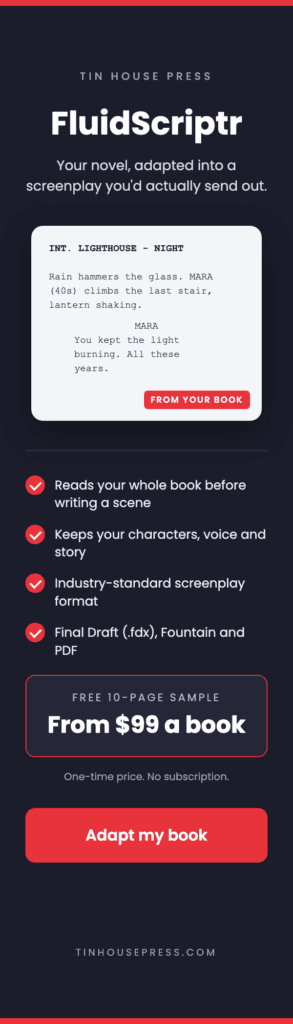
The hardest part of adapting is often the start: facing 300 pages of prose and a blank script. One way through is to convert first and adapt second. FluidScriptr lets you convert your novel into a screenplay draft: it breaks your manuscript into scenes, writes action in present tense, and sets dialogue in standard format. Its Conversion Fidelity Analysis shows how closely the draft follows your book, which is a useful map when you start deciding what to cut.
From there, the real adaptation work is yours: choosing the film’s spine, turning thought into action, and tightening every page. But you’ll be revising a script, not translating a novel line by line.
Related reading: How to Turn Your Novel Into a Screenplay · Should You Adapt Your Own Book Into a Screenplay?