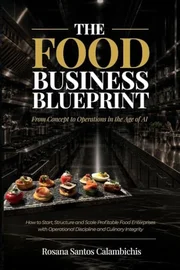

In her nonfiction debut, Calambichis offers advice and guidance to “those who want to build a food business with passion, discipline and purpose.” She provides worksheets and reference cards designed to translate her organizational ideas into practical real-world applications, focusing on three key frameworks: the “Blueprint Operating Model,” the “Blueprint Profit Framework,” and the “Blueprint Risk Matrix,” decision tools that “help clarify thinking, identify opportunities, and organize action in ways that intuition alone cannot always produce.” (The note about intuition not being sufficient appears throughout the book.) The author notes that food enterprises typically have two sides. One is passion-driven and emotional, involving treasured recipes and culinary traditions; the other is driven by the structure and discipline of operational thinking. The latter side gets the lion’s share of Calambichis’ attention in these pages, where she provides detailed advice about establishing and running a food business, from tips on laying the groundwork to considerations of financial risks, transportation delays, weather patterns, and supply chain issues. “Financial risk strength is built through disciplined cash flow management, clearly enforced payment terms, thoughtful growth pacing, and the maintenance of financial reserves,” she explains. The author regularly references the human elements of the process, noting, for instance, that customers are often more understanding about problems than operators think they’ll be. Calambichis writes with appealing clarity in this work, which will prove very useful to readers who are starting out in the food business. Equally valuable is the author’s tough-love acknowledgments of the realities of the business: “At some point, things will go wrong,” she writes. “Not occasionally. Inevitably.” Calambichis takes readers through every logistical reality of operations in a manner that nicely balances technical detail with philosophical frameworks and helps to position the material in a broader context. The inclusion of AI considerations feels a bit perfunctory, but the bedrock basics of the business are impeccably described.